

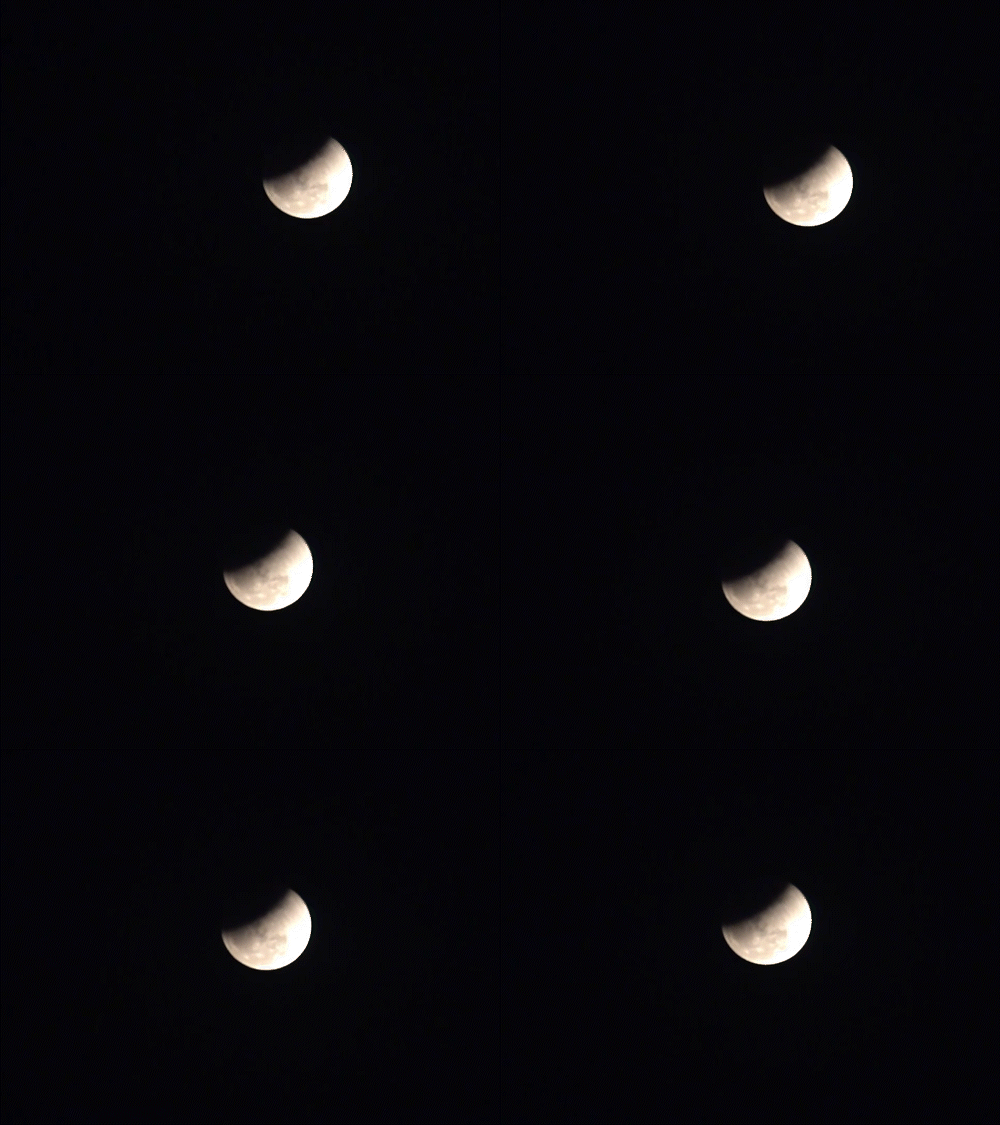
The first lunar eclipse of 2026 has ended. The lunar eclipse began at 3:21 pm on Tuesday (March 3, 2026) and lasted until 6:47 pm. The lunar eclipse was first visible in eastern India. In Kolkata, the full moon was partially visible due to the eclipse. After the eclipse ended, deities were bathed in temples. The temples reopened after the Shringar and Bhoga Aarti. Holi celebrations were held at the Shri Mahakaleshwar Temple in Ujjain during the Bhasma Aarti on Tuesday morning. The doors of the Mahakaleshwar Temple will not be closed. According to the India Meteorological Department (IMD), the total lunar eclipse on Tuesday (March 3, 2026) was visible. In India, the lunar eclipse was most visible in Tezu town, Arunachal Pradesh, where moonrise occurred at 5:03 pm. The lunar eclipse was visible across Asia, Australia, New Zealand, Antarctica, Russia, North America, and South America. The ‘Sutak period’ of the eclipse began in the morning. Temples across the country were closed after the Mangal Aarti in the morning.
2 photos of Holi celebrations at Mahakaleshwar Temple in Ujjain: 7 photos of closed temples: What is a lunar eclipse?
Gravitational force is the reason why the Earth and all other planets revolve around the Sun. The Earth orbits the Sun once every 365 days. The Moon, a natural satellite, orbits the Earth, taking 27 days to complete one revolution. During its orbit around the Sun, the Earth sometimes comes between the Sun and the Moon. During this time, sunlight cannot reach the Moon, and the Earth’s shadow casts on the Moon, resulting in a lunar eclipse. A lunar eclipse occurs only when the Sun, Earth, and Moon are aligned. According to astronomy, this is possible only on a full moon day. For this reason, most lunar eclipses occur only on a full moon day. There are three main types of lunar eclipses: 1. Total lunar eclipse: A total lunar eclipse occurs when the Earth, Sun, and Moon are in a straight line. Due to this, the Earth’s shadow completely covers the Moon, causing it to become completely dark. 2. Partial Lunar Eclipse: A partial lunar eclipse occurs when the Earth’s shadow covers only a portion of the Moon, rather than the entire Moon. During this time, only a small portion of the Moon is darkened. 3. Penumbral Lunar Eclipse: A penumbral lunar eclipse occurs when the Earth’s shadow falls on the outer portion of the Moon. This type of lunar eclipse is difficult to see. When was the first lunar eclipse discovered? In 280 AD, or 1742 years ago, a book was found in a tomb belonging to the Zhou Dynasty in China. Written in Chinese, the book was titled “Zhou Shu.” This book described lunar eclipses hundreds of years ago.
Researcher Professor S.M. Russell, citing this book, has given the date when humans first observed a lunar eclipse. According to them, humans first noticed a lunar eclipse on January 29th, 3158 years ago, in 1137 BC.
Why does the Moon appear red on a lunar eclipse? The Moon appears red only when it is in Earth’s shadow. This is because sunlight splits into seven colors as it enters Earth’s atmosphere.
During this period, the longest wavelength is deep red, and the shortest is violet. The shorter wavelengths are scattered through Earth’s atmosphere, but the deep red light bounces off the Moon and reaches us. This is why the Moon appears red during a lunar eclipse, and it is also called a blood moon. How many times can a lunar eclipse occur in a year? According to NASA, lunar eclipses usually occur twice a year. In some years, there may be as many as three. Of the total lunar eclipses that occur over a hundred years, approximately 29% are total. On average, a total lunar eclipse can be seen from a given location every 2.5 years. Lunar eclipses last from 30 minutes to an hour. The distance of the Moon from the Earth was determined during a lunar eclipse. 1. During a lunar eclipse in 150 BC, approximately 2100 years ago, Greek scientists determined the Earth’s diameter. This revealed how large the Earth is.
2. In 400 BC, Greek scientist Aristarchus determined the Earth’s distance from the Moon using a lunar eclipse.
3. Later, Greek astrologer Claudius Ptolemy created one of the world’s oldest world maps, the Ptolemy World Map, based on this data in the second century AD, approximately 1800 years ago. ———————— Read this news also: Lunar eclipse today: Sutak will end with the lunar eclipse at 6:47 pm, chant mantras and do charity during Sutak. Today (March 3) is also Falgun Purnima. Holika Dahan took place on the night of the 2nd, but due to the lunar eclipse today, Dhulandi is not being celebrated in most areas. Holi will be celebrated in these areas tomorrow, i.e., on March 4. Read the full news…


