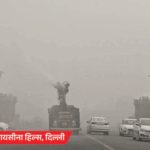


Congress MP Rahul Gandhi, the leader of opposition in Lok Sabha, has expressed concern over the rising air pollution in North India. Rahul said, ‘Air pollution in North India is a national emergency. It is a public health crisis, which is taking away the future of our children and suffocating the elderly. An environmental and economic disaster that is ruining the lives of countless people.’ He shared a video and message on his X account. In this, he is talking about air pollution at India Gate at 6 am. During this time, the AQI of the area is 396. In the video, Rahul and the moderator are discussing pollution in North India. He wrote, ‘The poorest among us are the worst sufferers, who cannot escape the poisonous air around them. Families are yearning for clean air, children are falling ill and millions of people are losing their lives. Tourism is declining and our global reputation is falling. Highlights of the conversation in the video shared by Rahul… Rahul – What are the components of pollution in Delhi. Many people say that burning of stubble and firecrackers are the reasons for this. But it cannot be just one thing. Moderator- This is not only a problem of Delhi and North India but of the entire country. Talking about Delhi-NCR, two types of sources are responsible for this. The first is episodic source, which includes burning of firecrackers and stubble. The second is perennial source, which includes sources that cause pollution for 365 days. 50% of Delhi’s air pollution is caused by vehicles. In this too, the number of private vehicles is high. Construction pollution is 30% of road dust. But people only talk about episodic sources. Rahul- The past week has been very difficult. I had complaints of irritation in the eyes. Damage remains throughout the year, but is more visible during these months (November to January). I tell my mother to leave from here during these months. Moderator- We suffer damage throughout the year. These days the AQI is at its peak. Understand that we live in 200 AQI throughout the year and these days it increases, goes up to 900, 1500, 1700. We are breathing in toxic air throughout the year. Rahul Gandhi- What is its solution? Moderator- If we know the source of pollution. Vehicle pollution is 50 percent and it is there throughout the year, then if there is political will, we can work on public transport. Rahul- How much will it cost to fix it? Moderator- If there is money for public transport, there is money for road construction. If a road built a month ago gets damaged, then somewhere the government is negligent. Thermal plants are also responsible for pollution. Every third child in Delhi has difficulty in breathing. The life of the people of Delhi is getting reduced by 10-12 years. What can be bigger than this. Supreme Court said on Delhi pollution- Not satisfied with the efforts of Delhi government
The Supreme Court reprimanded the Kejriwal government on November 22 regarding pollution in Delhi. The court said, ‘We are not satisfied with the efforts of the Delhi government. The government has not done anything to stop the entry of trucks.’ The bench of Justice Abhay S Oka and Justice Augustine George Masih has raised objections to the Delhi government’s move to control pollution. Despite the orders, Delhi Police failed to implement the Stage 4 restrictions on time. The GRAP-4 restrictions should remain in force for at least 3 more days. The next hearing of the case will be on November 25. The Supreme Court said, ‘Why are there only 13 CCTVs at 113 entry points. The central government should deploy police at all these entry points. A legal team should be formed which will see whether the entry of vehicles is actually being banned or not. For this, we will deploy young lawyers of the Bar Association.’ Read full news… GRAP is imposed when AQI crosses 400. It has been divided into 4 categories to check the pollution level of air. There are fixed standards and measures for each level. This is called Graded Response Action Plan (GRAP). Under its 4 categories, the government imposes restrictions and issues measures to reduce pollution. Stages of GRAP