

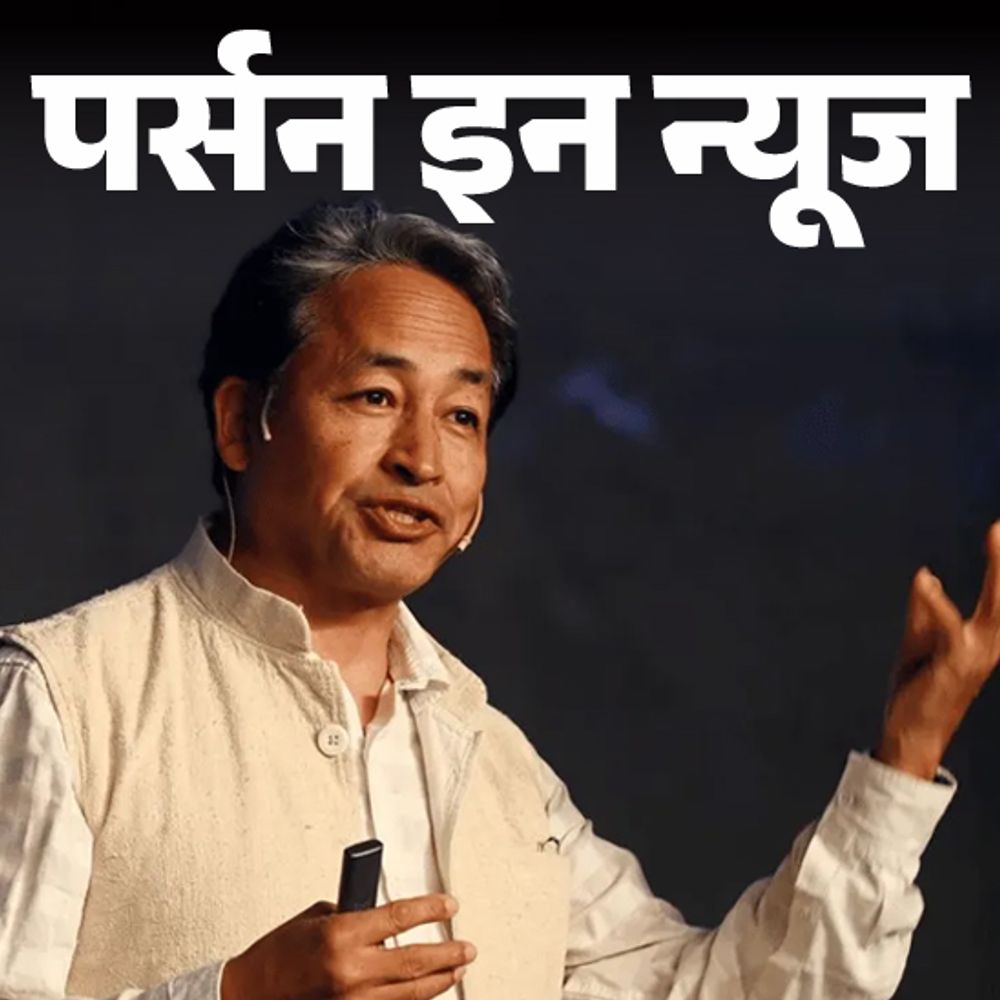
Sonam Wangchuk has been included in TIME magazine’s list of “The 100 Most Influential Climate Leaders of 2025.” The magazine wrote, “Wangchuk is an engineer, academic, and social activist. Last month, he was arrested during a protest demanding full statehood for Ladakh. For the past decade, he has been working to integrate ancient cultural traditions and new scientific technologies into the creation of artificial glaciers.” Wangchuk’s wife wrote on X, “Time magazine is including him among the world’s 100 most influential people. Our government is labeling him anti-national. The government is claiming that he (Sonam Wangchuk) poses a threat to national security.” Wangchuk was arrested in September. On September 10, Wangchuk and his supporters went on a hunger strike demanding full statehood for Ladakh, the Sixth Schedule, and other demands. A shutdown was also called in Leh on September 24. Subsequently, members of the Kargil Democratic Alliance also supported the shutdown and announced a shutdown across Ladakh. Subsequently, the shutdown turned violent in Leh, injuring at least 60 people. In a late-night statement, the Union Home Ministry blamed Sonam Wangchuk for the violence. The ministry stated that Wangchuk incited the crowd by citing the “Arab Spring” and “Gen Z” movements. Following the violence, Wangchuk issued a statement, breaking his 15-day fast and appealing to youth to maintain peace. He is currently incarcerated in Jodhpur Central Jail under various sections, including the National Security Act (NSA). Homeschooled for nine years, Wangchuk was born in 1966 near Alchi in Leh district, Ladakh. Due to the lack of a school in his village, he was not enrolled in any school until the age of nine. During this time, his mother provided him with basic education. At the age of nine, he was taken to Srinagar and enrolled in a school there. Later, he studied at a special central school in Delhi. He then earned a B.Tech in mechanical engineering from the National Institute of Technology (NIT), Srinagar. He founded SECMOL to improve education. After graduating from engineering, Wangchuk, along with his brother and five friends, founded the Students’ Educational and Cultural Movement of Ladakh (SECMOL) in 1988. Its objective was to improve education in government schools in Ladakh. To this end, school reform experiments were conducted at the government high school in Saspol, Ladakh. Subsequently, SECMOL launched “Operation New Hope,” which initiated education reform in government schools, including the introduction of localized textbooks, teacher training, and the formation of village-level education committees. This initiative was then furthered with the support of the education department and village residents. In June 1993, Wangchuk launched the print magazine “Ladakh’s Melong.” He served as editor of Ladakh’s only print magazine until August 2005. In 2004, he was appointed education advisor to the Hill Council government. In 2002, along with several NGO leaders, he founded the Ladakh Voluntary Network (LVN), a network of Ladakhi NGOs. He served as Secretary on its Executive Committee until 2005. In 2004, he was appointed to the drafting committee of the Ladakh Hill Council Government’s vision document, “Ladakh 2025,” and was responsible for formulating policies on education and tourism. This document was formally launched by Indian Prime Minister Manmohan Singh in 2005. Wangchuk initiated the Ice Stupa Project in late 2013. Its aim was to find a solution to the water shortages faced by Ladakhi farmers during sowing in April and May. By the end of February 2014, he had successfully built a prototype of a two-story Ice Stupa, capable of storing approximately 150,000 liters of water. An ice stupa is an artificial glacier that stores water in the winter and melts slowly in the summer, ensuring water availability for agriculture and gardening. This technology gained international recognition. He extended it not only to Ladakh but also to other regions in the Himalayas and Alps. Wangchuk founded the Himalayan Institute of Alternatives Ladakh (HIAL) in 2016. This is an alternative university that trains young people in the Himalayan region to address challenges such as education, culture, and the environment. The university’s programs teach students solutions to local problems such as glacier melt and low rainfall. ———————– Read this news too… Jemimah Rodriguez is also a national-level hockey player: She was selected for the Under-19 cricket team at the age of 13; she also went viral with her singing; learn about her profile. Team India reached the final for the third time on Thursday after defeating Australia by 5 wickets in the semi-finals of the Women’s ODI World Cup. The team achieved the highest run chase in a women’s ODI. The hero of this match was middle-order batsman Jemimah Rodrigues. Jemimah became the second-highest run-scorer for India in a World Cup knockout. She also scored a personal best of 127. Read the full story…


