

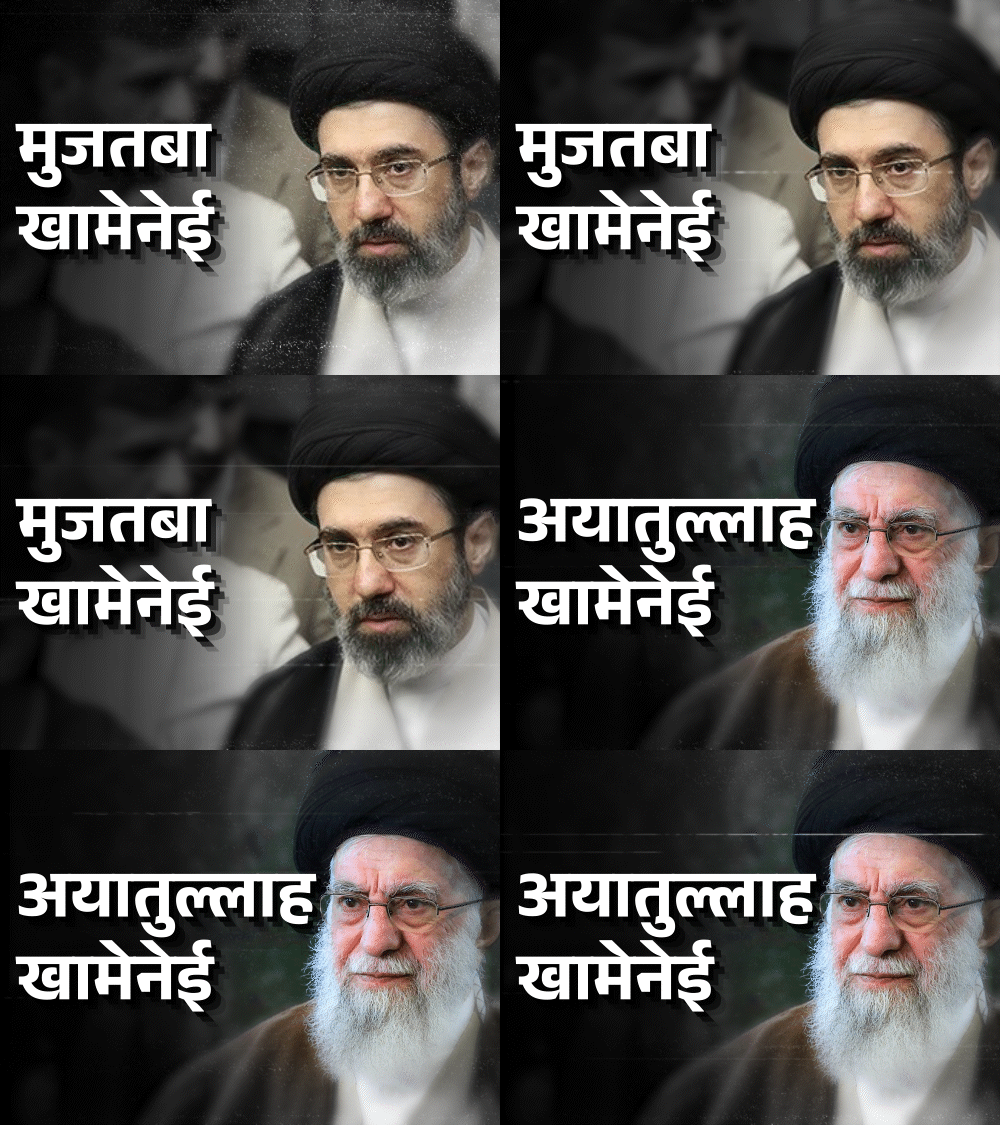
Following the death of Iran’s Supreme Leader, Ayatollah Ali Khamenei, in a US-Israeli attack, the most pressing question is who will replace him. This is especially true because the Supreme Leader of Iran is more powerful than the President. Iran has not yet announced the name of the new Supreme Leader, but according to several media reports, including the state-run Fars media, his son, Mojtaba Khamenei, may be elected to the position. Preparations to appoint him Supreme Leader have been underway for the past two years. In Iran, the Supreme Leader is called “Rahbar,” meaning “guide” or “shower of the way.” An assembly of 88 clerics elects the Supreme Leader. Iran and Vatican City are the only countries in the world where religious leaders hold the most power. The Supreme Leader’s status in Iran is similar to that of the Pope in the Vatican. Before we learn about Iran’s potential new Supreme Leader, a photo of the attack that killed Khamenei on Saturday… Khamenei appointed Mujtaba as his successor due to illness. Iran’s Supreme Leader, Ayatollah Ali Khamenei, designated his second son, Mujtaba Khamenei, as his successor in 2024. Khamenei made this decision due to illness, although this has not been officially confirmed. According to reports, Iran’s Expert Assembly had already elected the new Supreme Leader on September 26, 2024. Khamenei convened 60 members of the Assembly and asked them to decide on a successor in secret. Following Khamenei’s death, Mujtaba may now publicly emerge as a contender for the position of Supreme Leader. Mujtaba Khamenei is an expert on Islamic affairs. Like his father, Mujtaba is an expert on Islamic affairs. He first came to the world’s attention in 2009. He harshly suppressed the ongoing protests in Iran, resulting in the deaths of many people. At that time, hardline leader Mahmoud Ahmadinejad won the presidential election over reformist leader Mir Hossein Mousavi. Reformist leaders claimed that the election was rigged. Millions of people took to the streets, dubbed the “Iranian Green Movement.” It lasted for two years, but was suppressed by the Iranian government using force. It was said that Mojtaba Khamenei was the mastermind behind it. Mujtaba held no office, nor did he give speeches. Despite his absence from the government, his involvement in important decisions steadily increased. Reports indicate that Mujtaba is a mysterious figure, rarely seen on public occasions. Unlike his father, he avoids public speeches. It is said that Mujtaba has influence within Iran’s intelligence and other government agencies. Mujtaba’s stature rose significantly after Ebrahim Raisi became president. Mujtaba was being groomed to succeed Raisi, i.e., the presidency of Iran, but this changed after Raisi’s death. The Five Most Powerful People and Institutions in Iran i. The Rehbar: In Iran, the Rehbar decides on the country’s government, military, society, and foreign policy. He is also the commander-in-chief of all armed forces. Only two people have held this position so far. Khamenei served as the Rehbar for 37 years. In Iran, the Rehbar, the Assembly, the Guardian Council, the President, and the Parliament jointly run the country. However, the real power always rests with the Rehbar. ii. The Assembly of Experts: This is comprised of 88 religious leaders. The public elects its members every eight years. This assembly elects the Rehbar and monitors his work. If the Rehbar performs poorly, it can even remove him. iii. The President: The President is the second most powerful leader in the country. He runs the government and assists in foreign policy, but the final decision always rests with the Rehbar. The approval of the Guardian Council is required to become president. iv. Guardian Council: It consists of six religious leaders and six judges. The leader elects them every six years. This council can also block laws made by the parliament. v. Parliament: It consists of 290 members, elected by the public every four years. Parliament makes laws, passes the budget, and, if necessary, can take action against the president or ministers. Now, learn about the assassinated Supreme Leader Ayatollah Ali Khamenei… Ayatollah Ali Khamenei was born on April 19, 1939, into a cleric family in the religious city of Mashhad, Iran. He opposed the policies of Reza Shah Pahlavi and advocated Islamic rule. In 1963, he was arrested for giving a speech against the Shah. Gradually, he became a major figure in the anti-government movement and was considered a trusted ally of Khomeini. In 1979, the Islamic Revolution took place in Iran, and the Shah’s government fell. Khomeini returned to the country and formed a new Islamic government. Khamenei was included in the Revolutionary Council and later appointed Deputy Defense Minister. In 1981, Khamenei was bombed while delivering a speech at a mosque in Tehran. The same year, another bombing killed the then-president. In the subsequent elections, Khamenei won a landslide victory and became Iran’s third president. After Khomeini’s death in 1989, Khamenei was appointed the country’s supreme leader, or “Rahbar,” and the constitution was amended to achieve this. Supporters consider him a strong defender of the Islamic system, while critics accuse him of running a strict and rigid regime. Three photos of Khamenei… Khamenei held supreme power in Iran for 37 years. Ayatollah Ali Khamenei held the position of Supreme Leader of Iran since the death of Ruhollah Khomeini in 1989. During the 1979 Islamic Revolution in Iran, when Shah Mohammad Reza Pahlavi was overthrown, Khamenei played a major role in the revolution. Following the Islamic Revolution, Khamenei was appointed President in 1981, a position he held for eight years. Following the death of Iran’s Supreme Leader Khomeini in 1989, he was appointed successor. Now, let’s explore the issues that led to the conflict between Iran and Israel: Nuclear Program: The United States suspects Iran may attempt to develop nuclear weapons, leading to repeated sanctions. Iran maintains that its nuclear program is solely for power generation and scientific research, not for weapons production. Ballistic Missile Issue: Iran’s missile program remains a major obstacle in nuclear negotiations. Iran clearly states that its ballistic missiles are essential for its security and that there will be no compromise on this issue, considering it its “red line.” Conflict Over Israel: The United States is Israel’s biggest supporter. Meanwhile, Iran openly opposes Israel and accuses it of spreading instability in the region. This further escalates tensions between the two countries. Interference in the Middle East: The US alleges that Iran is expanding its influence by supporting pro-Israel groups in countries like Iraq, Syria, Lebanon, and Yemen. Iran maintains that it is protecting its interests and allies. Economic Sanctions: The US has imposed strict economic sanctions on Iran, which have impacted its economy. In response, Iran sometimes takes steps such as accelerating its nuclear program or issuing harsh statements. Find out what Trump has said about Iran so far… ————————— Read other news related to the Iran-Israel war… Iranian Supreme Leader Khamenei killed in US-Israeli attack: Daughter, son-in-law, daughter-in-law, and granddaughter also killed; Iranian army says, “The most dangerous attack will be carried out shortly.” Iranian Supreme Leader Ayatollah Ali Khamenei has been killed in the US-Israeli attack. Iranian media Tasnim and Fars news agencies have confirmed this. Khamenei’s daughter, son-in-law, granddaughter, and daughter-in-law were also killed in the attack. Iran has declared 40 days of state mourning and seven public holidays. Read the full story…