

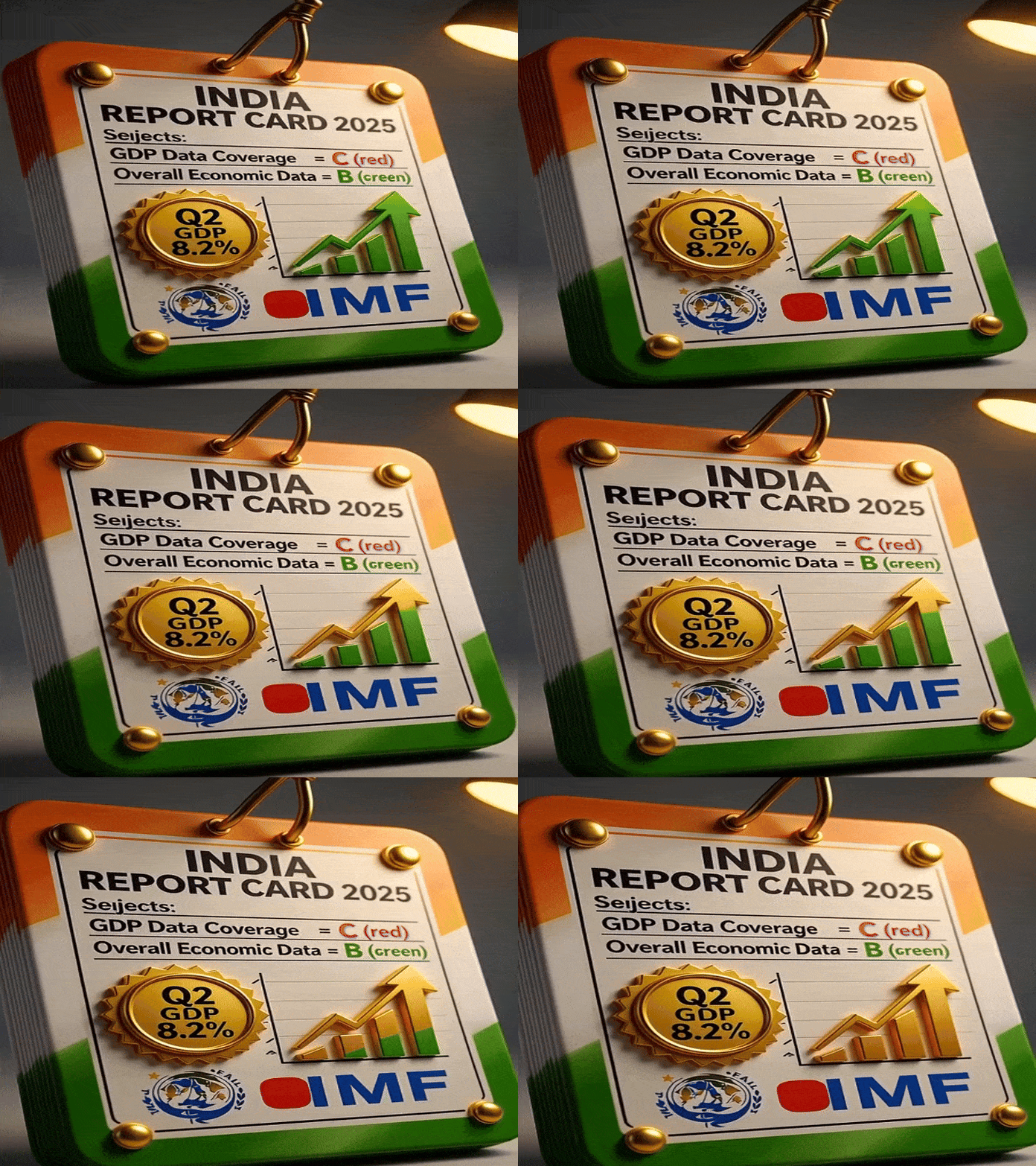
Imagine you’re in school and your report card arrives. You got a C in Math, but a B in the other subjects… meaning you passed, but there’s room for improvement. This is exactly what happened to our country’s economy. On November 26th, the IMF gave India’s GDP data a ‘C’ grade. The very next day, on November 27th, the government released GDP figures for Q2, i.e., July-September 2025. It stated that our country’s economy grew at a rate of 8.2% in the second quarter. This exceeds everyone’s expectations and is also the fastest-growing economy in the world. Now, opposition parties are raising questions, citing the IMF report, saying that the GDP growth figures are unreliable. It’s also worth noting that the 2024 report on Pakistan’s economy also gave our neighboring country a C grade. This means that the IMF believes that official data from both India and Pakistan have similar shortcomings. In this news article, let’s understand whether there’s something wrong with the GDP data. What does the IMF’s C grade mean? Is it fair for India and Pakistan to receive the same rating? First, look at these two tables… Analysis of the IMF report in three points: Three things need to change to achieve an A grade… New base year: The 2011-12 base year needs to be changed. It’s still in use. Its data doesn’t accurately reflect the current economy, whereas globally, it’s updated every five years. India is going to change it next year, i.e., in 2026. The new base year will be 2022-23. Data coverage: It needs to be expanded. The informal sector (90% of workers – street vendors, small shopkeepers, and home-based workers) isn’t currently properly accounted for. This will provide a clearer picture of the economy, eliminating any gaps. It’s expected to improve in the 2026 series. New Index: Currently, we look at WPI (Wholesale Price Index), which means the wholesale price at which a shopkeeper purchased goods from a factory. This does not account for the actual manufacturing costs. Therefore, WPI should be replaced by PPI (Producer Price Index), which directly reflects factory costs. Is there really something wrong with the GDP data? Government: Prime Minister Modi said, “The 8.2% GDP growth in the second quarter of 2025-26 is very encouraging. It reflects the impact of our growth-friendly policies and reforms.” Finance Minister Nirmala Sitharaman said, “The GDP data clearly shows the strong growth and momentum of the Indian economy.” Allegations: Congress leader Jairam Ramesh said, “It is ironic that the quarterly GDP figures have been released at a time when the IMF report gave the Indian National Accounts Statistics a ‘C’ grade. The economic data is still disappointing. There is no growth in private investment.” Answer: Some analysts say that these figures are real. There are some shortcomings, but it would not be entirely accurate to call them a discrepancy. A ‘C’ grade is a warning sign of improvement. The release of a new GDP series in 2026 could improve the grade. The IMF has already given the economy an overall rating of B. Is it fair for India and Pakistan to receive the same rating? The IMF gave India and Pakistan the same C grade in GDP data because the accounting methodology is nearly identical in both countries. The accounts of small shopkeepers, street vendors, and home-based workers are not properly included, the base year is outdated, and the methodology is also outdated. The IMF ignored the fact that one country has democracy and the other has a background military influence. It only considered the number of errors. However, India is far ahead of Pakistan in the overall scoresheet. India’s growth rate was 8.2%, while Pakistan remained stuck at 5.70%. This means that both countries are equal in accounting quality, but India is ahead in actual performance. Despite the pressure of US tariffs, GDP grew by 8.2%. There is pressure of US tariffs in the world including India, private investment is sluggish, yet India’s economy grew at the rate of 8.2% in the July-September quarter. This is the highest in the last 6 quarters. In the same quarter last year, GDP was 5.6%. Whereas in April-June it was 7.8%. It is clear from the data of National Statistical Office (NSO) that rural demand, government spending and the pace of manufacturing have given a boost to the economy. The full effect of GST rate cut is yet to come, but these results are better than expected. GDP tells the health of the economy. GDP is used to track the health of the economy. It shows the value of all goods and services within the country in a given period. The production done by foreign companies while staying within the country’s borders is also included in it. There are two types of GDP. GDP is of two types. Real GDP and Nominal GDP. In real GDP, the value of goods and services is calculated at the base year’s value or constant price. Currently, the base year for calculating GDP is 2011-12. Whereas nominal GDP is calculated at current prices. How is GDP calculated? A formula is used to calculate GDP. GDP=C+G+I+NX, here C means private consumption, G means government spending, I means investment and NX means net exports.